I am a freelance writer, author and editor with more than 20 years' experience in national newspapers. My book In Search Of Alan Gilzean was shortlisted for football book of the year at the 2011 British Sports Book Awards. In 2018, I was a finalist in the sports feature writer of the year category at the Scottish Press Awards. My work has appeared in The Times, The Herald, Glasgow Times, Sunday Herald, Herald on Sunday, Daily Mirror and Nutmeg magazine.
Riding out almost done . . . one at Hexham today . . . then Kavos tomorrow #boom
TWENTY-FOUR hours after Campbell Gillies wrote the above sentence on Twitter, he was dead.
The 21-year-old, Scotland’s most promising National Hunt jockey in a generation, had travelled to the Greek island with a group of fellow jockeys and Mark Ellwood, head lad at Scottish trainer Lucinda Russell’s Arlary House stables, to celebrate Gillies’ 22nd birthday.
Early one morning the friends went swimming. They were in high spirits after a night out and challenged each other to see who could hold their breath under water for the longest. Campbell did not resurface and all attempts to revive him were in vain.
Gaizka Mendieta spends so much of his time looking forwards, that it almost seems an imposition to ask him to cast his glance back the way.
As a DJ, restaurateur, broadcaster and recent graduate from a UEFA course in football administration, his diary has never been fuller. He likes it that way, better to be busy than to sit watching the walls close in. It is a Tuesday afternoon; the sound of traffic and birdsong fills the London air as Mendieta discusses his daily regime.
Paul McAreavey is recalling a harrowing tale of life growing up in Belfast at the height of the Troubles. Aged nine, he was sitting in his living room when he heard shots fired from outside. His father Danny, an avid reader, had just left to pick up his latest collection of books from the library. Panic struck the McAreavey household.
“We all ran outside because we thought it was him,” McAreavey says. “He was sitting in his car; it was our next door neigbour who had been shot by loyalist paramilitaries. His brother was a paramilitary and they couldn’t get to him so they went after our neighbour. A couple of years later they shot him again.”
Anyone who hears the tale agrees it should be made into a film. It could well be, soon enough. The script needs little in the way of embellishment.
It’s 1964. Moville and Buncrana are in the midst of an arms race. The neighbouring Donegal towns are making preparations for their summer cup football competitions. Moville leads the way by a short head. A donkey, named after Irish Derby winner Ballymoss has been auctioned; for good measure a pony is put up for a raffle prize, just two of a number of schemes aimed at raising the £2000 prize money that has made Moville’s Kennedy Cup the pre-eminent competition in the north of Ireland.
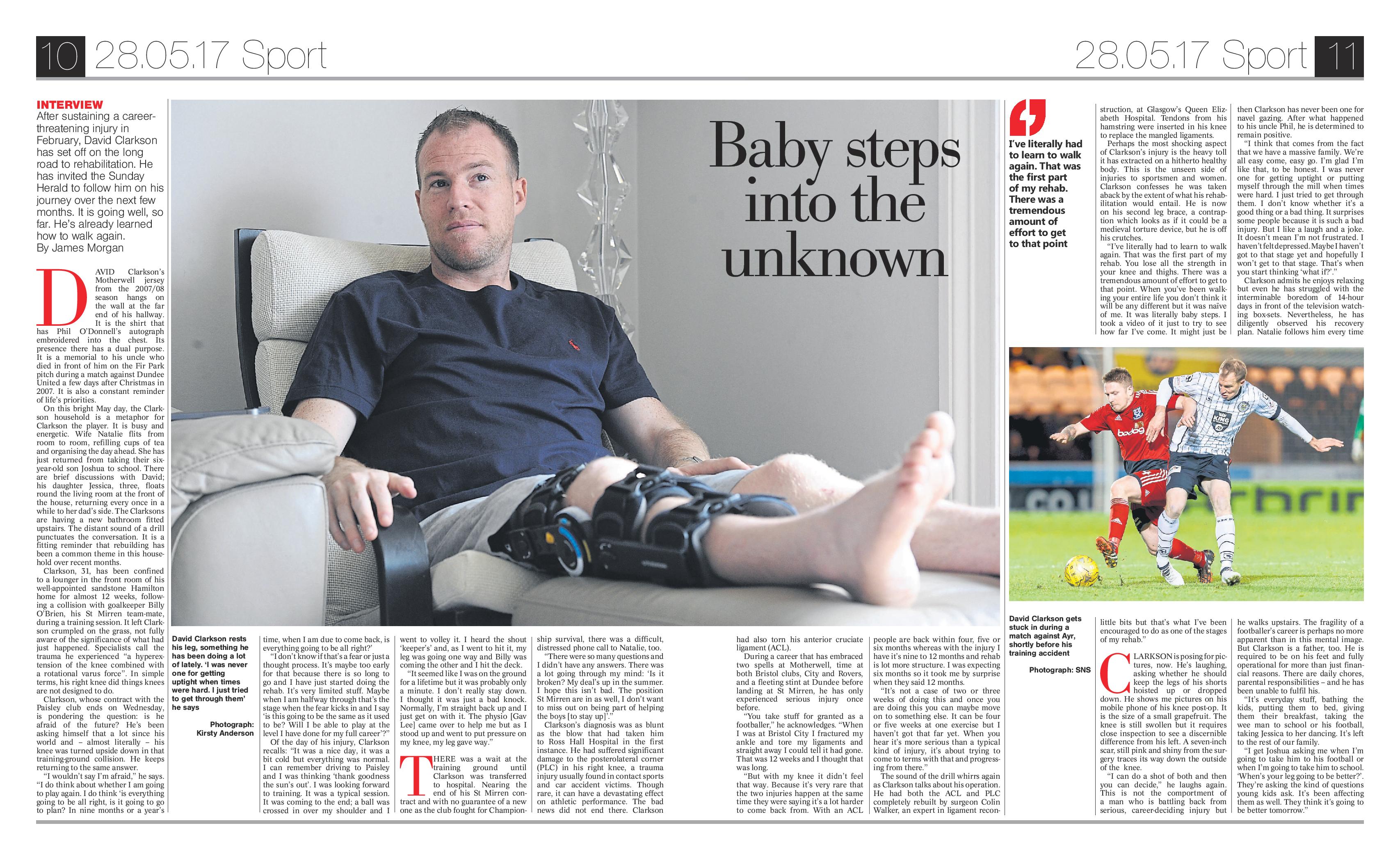
David Clarkson’s Motherwell jersey from the 2007/2008 season hangs on the wall at the far end of his hallway. It is the shirt that has Phil O’Donnell’s autograph embroidered into the chest. Its presence there has a simultaneous purpose. It is a memorial to his uncle who died in front of him on the Fir Park pitch during a match against Dundee United at Christmas 2007. It is also a constant reminder of life’s priorities.
On this bright May day, the Clarkson household is a metaphor for Clarkson the player. It is busy and energetic. Wife Natalie flits from room to room, refilling cups of tea and organising the day ahead. She has just returned from taking their six-year-old son Joshua to school. There are brief discussions with David; his three-year-old daughter Jessica floats around the living room at the front of house, returning every once in a while to her dad’s side. The Clarksons are having a new bathroom fitted upstairs. The distant sound of a drill punctuates the conversation. It is a fitting reminder that rebuilding has been a common theme in this household over recent months.
Clarkson has been confined to a lounger in the front room of his well-appointed sandstone Hamilton home for almost 12 weeks. He has been recuperating from the effects of an accidental collision with Billy O’Brien, the St Mirren goalkeeper, during a training session at the end of February. It left Clarkson lying crumpled on the grass, not fully aware of the significance of what had just happened. Specialists call the trauma experienced by Clarkson “a hyperextension of the knee combined with a rotational varus force”. In simple terms, his right knee did things knees are not designed to do.Clarkson is pondering the question: is he afraid of the future? He’s been asking himself that a lot since his world and – almost literally – his knee was turned upside down in that training-ground collision in February. He keeps returning to the same answer.
“I wouldn’t say I’m afraid,” he says. “I do think about whether I am going to play again. I do think ‘is everything going to be all right, is it going to go to plan? In nine months or a year’s time, when I am due to come back, is everything going to be all right?’ I don’t know if that’s a fear or just a thought process. It’s maybe too early for that because there is so long to go and I have just started doing the rehab. It’s very limited stuff that I’m doing just now. Maybe when I am halfway through that’s maybe the stage when the fear kicks in and I say ‘is this going to be the same as it used to be? Will I be able to play to the levels that I have done for my full career?’“It was a nice day, the sun was out, it was a bit cold but everything was normal,” he recalls of the fateful day. “I can remember driving to Paisley and I was thinking ‘thank goodness the sun’s out’. I was looking forward to training. It was a typical training session really. It was coming to the end; a ball was crossed in over my shoulder and I went to volley it. I heard the shout ‘keeper’s’ and as I went to hit it my leg was going one way and Billy was coming the other way and I hit the deck.“It seemed like I was lying on the ground for a lifetime but it was probably only a minute. I don’t really stay down. I thought it was just a bad knock. Normally, I’m straight back up and I just get on with it. The physio [Gav Lee] came over to help me but as I stood up and went to put pressure on my knee, my leg gave way.”
There was a wait at the training ground until he was transferred to hospital. With Clarkson nearing the end of his St Mirren contract and no guarantee of a new one with the club fighting for Championship survival, there was a difficult, distressed phone call to Natalie, too.“There were so many questions and I didn’t have any answers. There was a lot going through my mind at that time: ‘is it broken? My deal’s up in the summer. I hope this isn’t bad. The position St Mirren are in as well I don’t want to miss out on being part of helping the boys [to stay up]’.”Clarkson’s diagnosis was as blunt as the blow that had taken him to Ross Hall Hospital in the first instance. He had suffered significant damage to the posterolateral corner (PLC) in his right knee, a trauma injury usually found in contact sports and car accident victims. Though rare, it can have a devastating effect on athletic performance. The bad news did not end there for Clarkson. PLCs rarely occur in isolation. Clarkson, aged 31, had also torn his anterior cruciate ligament.The sound of the drill whirrs again as Clarkson talks about his operation. He had both the ACL and PLC completely rebuilt by surgeon Colin Walker, an expert in ligament reconstruction, at Glasgow’s Queen Elizabeth Hospital. Tendons from his hamstring were inserted in his knee to replace the mangled ligaments.
Perhaps the most shocking aspect of Clarkson’s injury is the heavy toll it has extracted on a hitherto healthy body. This is the unseen side of injuries to sportsmen and women. We view them as physically superior but in the final analysis they are flesh and bones like the rest of us. Clarkson confesses he was taken aback by the extent of what his rehabilitation would entail. He is now on his second leg brace, a contraption which looks as if it could be a medieval torture device, but he is off his crutches.“I’ve literally had to learn to walk again. That was the first part of my rehab. You lose all the strength in your knee and thighs. There was a tremendous amount of effort to get to that point. When you’ve been walking your entire life you don’t think it will be any different but it was naïve of me. It was literally baby steps. I took a video of it just to try to see how far I’ve come. It might just be little bits but that’s what I’ve been encouraged to do as one of the stages of my rehab.”
Clarkson is posing for pictures, now. He’s laughing, asking whether he should keep the legs of his shorts hoisted up or dropped down. He shows me pics on his mobile phone of his knee post-op. It is the size of a small grapefruit. The knee is still swollen but it requires close inspection to see a discernible difference with his left. A seven-inch scar, still pink and shiny from the surgery traces its way down the outside of Clarkson’s knee.
“I can do one of both and then you can decide,” he laughs again. This is not the comportment of a man who is battling back from serious, career-deciding injury but then Clarkson has never been one for navel gazing. After what happened to his uncle Phil, he is determined to remain positive.“I think that comes from the fact that we have a massive family. We’re all easy come, easy go. I’m glad I’m like that, to be honest. I was never one for getting up tight or putting myself through the mill when times were hard. I just tried to get through them. I don’t know whether it’s a good thing or a bad thing. It surprises some people as well because it is such a bad injury. But I like a laugh and a joke. It doesn’t mean I’m not frustrated. I haven’t felt depressed. Maybe I haven’t got to that stage yet and hopefully I won’t get to that stage. That’s when you start thinking ‘what if?’”
Clarkson admits he enjoys relaxing but even he has struggled with the interminable boredom of 14-hour days in front of the television watching box-sets. Nevertheless, he has diligently observed his recovery plan. Natalie follows him every time he walks upstairs. The fragility of a footballer’s career is perhaps no more apparent in this mental image. But Clarkson is a father, too. He is required to be on his feet and fully operational for more than just financial reasons. There are daily chores to be carried out, parental responsibilities – and he has been unable to fulfil his.
“It’s every day stuff, bathing the kids, putting them to bed, giving them their breakfast, taking the wee man to school or his football, taking Jessica to her dancing. It’s left to the rest of our family. I get Joshua asking me when I’m going to take him to his football or when I’m going to take him to school. ‘Can you pick me up from school?’ ‘When’s your leg going to be better?’ They’re asking the kind of questions young kids ask. It’s been affecting them as well. They think it’s going to be better tomorrow.”
It wasn’t meant to be like that. Looking back, though, it was inevitable. I’d supported Glentoran all my life, as had my brother Chris. We were simply following the lead of my father, as young boys do, by supporting the club he had grown up watching.
So when Trevor Anderson, the then manager of Glentoran’s bitter rivals Linfield, arrived at our front door one Saturday morning to ask my brother to sign for his side, I’d half expected my father to chase him down the street in his slippers. But “Trevor” was shown into our ‘good room’ by my dad with my brother in tow, my mother made tea and biscuits. “Trevor” even shook my hand.
This wasn’t happening, was it? My brother, who I’d played football all my life with, was going to sign for the team we’d both hated as kids. We’d played football everywhere, in the street, in the local playing fields, and once, even, in a half-finished extension on mum and dad’s house at Moyra Crescent. We were a dynamic duo. I played him in and he scored. Northern Ireland reached the semi-finals of the World Cup in 1986 on the back of our performances, Chris a 10-year-old goal getter and me the slightly older, more worldly wise midfield playmaker.
Him moving on to better things wasn’t meant to be part of the double act, but you learn that when you leave childhood. Life always moves on and sometimes your own dreams become someone else’s reality.
In the end Chris didn’t sign for Linfield that summer. It took another year and another manager, David Jeffrey, before he left his club Crusaders for the relatively bright lights of Windsor Park.
And then something else happened. My dad died in 1999 after a short, ugly battle with cancer.
League titles followed for Chris, League Cups, too, but never an Irish Cup. Until 2002 that is, for a match against the League champions Portadown, who were favourites to complete the double.
Portadown took an early lead and then Chris took over.
His first goal lifted the roof. The ball arrowed into the top corner and extended out past the stanchion. When I see it in my mind’s eye now, the ball seems to have the effect of a match striking the side of a match box, there’s the spark as it smacks the net and then the full blast as 20,000 supporters realise what has happened. The flames of noise spreading expeditiously around the crowd like a line of flaring gunpowder.
His second won the cup. I knew it was coming, I had seen the goal a hundred times before, Chris sidefooting the ball past the advancing keeper, just as he had done in that World Cup quarter-final win over Brazil outside our front door in Moyra Crescent. I was one of the cheering mob – a life-long Glentoran fan, in raptures at a goal for Linfield.
Afterwards, the revelry spilled over into the car park outside Windsor Park. There were tears in my eyes as I approached Chris. He was surrounded by a throbbing mass of Linfield supporters but I got close enough to him to shake his hand and whisper in his ear “he would have been very proud.”. But there was a fierce din and in any case he was somewhere else. Transported to some blissfully euphoric place I could only imagine.
We’ve never talked about it since but I’ve often wondered if he spoke to my dad when he was there.
 James Morgan